
Appearance
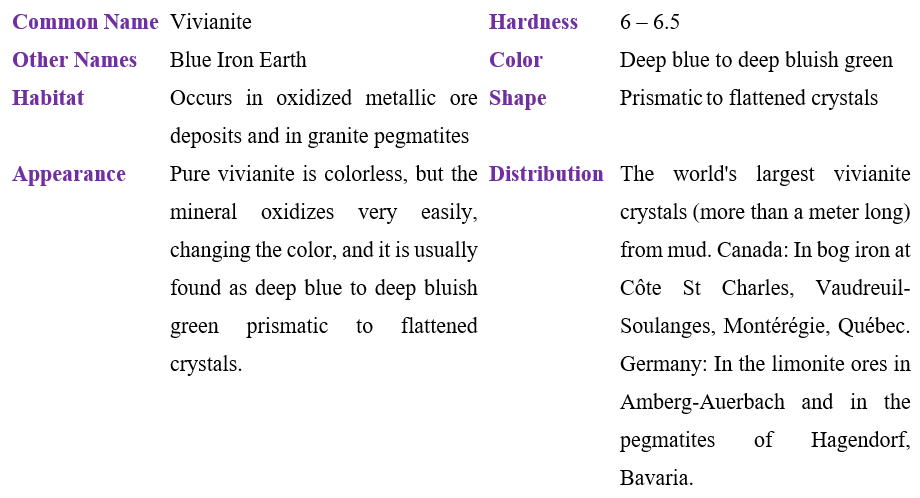
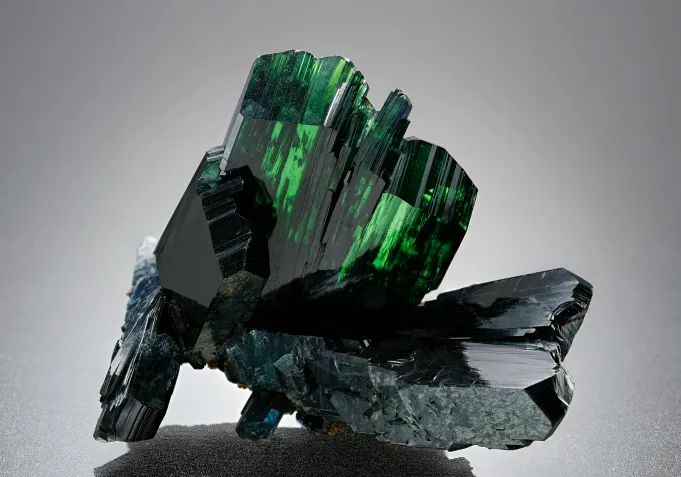
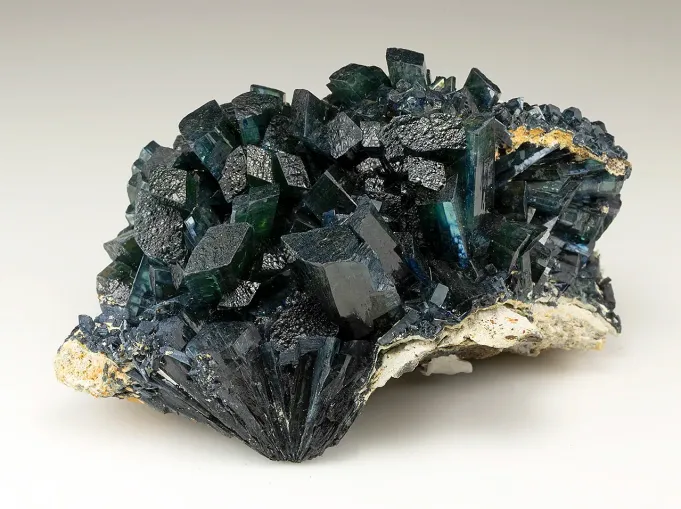
Vivianite is primarily recognized for its deep blue to blue-green color, which can vary in strength. When it weathers or becomes dehydrated, it can also seem colorless, white, grey, or yellowish. Depending on the crystal structure and the particular environmental conditions in which it occurs, the luster of vivianite can range from vitreous to silky. It can be translucent or transparent; thinner crystals are usually more transparent. Because vivianite crystallizes in the monoclinic crystal system, each of its three uneven axes is angled with respect to the other two.
Geographical Distribution
The mineral originates in anaerobic (low oxygen) environments and is frequently linked to iron ore deposits. Although it is still regarded as somewhat rare, vivianite has been found in a few different places despite not being a mineral that is mined extensively. Some locations where vivianite has been discovered are as follows:
Bolivia: The Huanuni mine is one among the locations in Bolivia where vivianite has been discovered. The crystals of Bolivian vivianite have a vivid blue to blue-green color.
Germany: Vivianite has been found in a number of German sites, including the Hesse region, where quantities of iron ore are found.
Russia: Reports of vivianite have come from Siberia and the Urals in Russia. Wetland and marshy environments are common locations for the mineral.
United States: States with iron-rich geology are the best places to find vivianite in the US. There have been reports of vivianite in parts of Virginia, Pennsylvania, and New Jersey.
England: According to historical accounts, vivianite can be found in some mining districts of the country, such Cornwall.
History
Early 19th-century mining owner and British industrialist John Henry Vivian made the discovery of vivianite, which led to its naming. Vivian was a well-known person in the mining and metallurgical industries. She lived from 1785 to 1855. He is renowned for having made significant contributions to Cornwall, England’s coal and copper mining sectors. In 1817, Vivianite was first discovered and given a name.
Chemical Composition
The composition of vivianite is shown by its chemical formula, which is Fe3(PO4)2·8H2O. The elements that make it up are as follows:
Fe: The principal metal in vivianite, iron (symbol Fe), is responsible for some of its color. A vital element of the mineral’s crystal structure are iron ions (Fe2O).
PO4: One phosphorus atom and four oxygen atoms make up the phosphate (PO4³⁻) group. It is in charge of vivianite’s phosphorus content.
8H2O: According to this portion of the formula, the structure of vivianite has eight water molecules (H2O). For vivianite crystals to form and remain stable, water is essential.
Uses
Because of its softness, sensitivity to environmental changes, and low quantity, vivianite does not have many industrial or commercial uses. Nonetheless, there are a few specialized markets where vivianite might find use or application:
- Mineral Collecting: Because of its unusual formation conditions and eye-catching blue to blue-green crystals, vivianite is highly valued by mineral collectors and aficionados. Vivianite specimens with good form are prized by collectors as eye-catching additions to their mineral collections.
- Art and Pigments: Throughout art history, vivianite has been employed as a blue pigment, particularly in watercolor paints. Artists were drawn to it because of its brilliant color. However, because of its sensitivity to light and air, which can alter and fade color, its employment in this context has gradually decreased.
- Historical Research and Geology: Geologists and scholars looking into historical mining and mineral occurrences are interested in vivianite. It can shed light on historical mining methods, geology, and atmospheric conditions.
- Phosphate Source in Agriculture: Vivianite does contain phosphorus, a nutrient that is crucial for plant growth even though it is not a primary source of phosphate. Vivianite-containing minerals have been employed as a small supply of phosphorus in agriculture in some areas, although more accessible and dependable sources, such as phosphate rock, are preferred.
Table